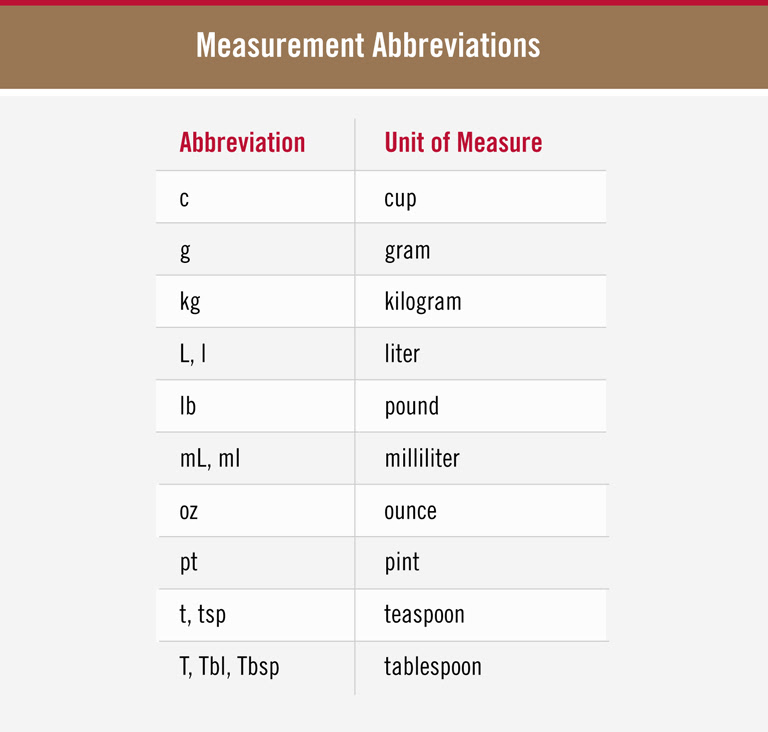
Both commercial kitchens and home cooks use a system of abbreviations for cooking measurements, some of which are easy to confuse. Mistaking a tablespoon for a teaspoon is a quick way to destroy entire recipes, so memorizing these abbreviations is vital. Below, we listed all standard cooking measurement abbreviations you might encounter in the kitchen.
Imperial System
The following abbreviations are standard in the imperial system of measurements.
- Teaspoon = t or tsp
- Tablespoon = T, TB, or tbsp
- Cup = C or c
- Pint = pt
- Quart = qt
- Gallon = gal
- Ounce = oz
- Fluid ounce = fl oz
- Pound = lb
Metric System
The following abbreviations are standard in the metric system of measurements.
• Milliliter = mL
- Liter = L or l
- Gram = g
- Kilogram = kg
Liquid measuring cups vs. dry
Liquid measuring cups are designed for measuring liquid ingredients like water, milk, and cooking oil. They feature measurement lines that allow you to accurately measure liquids without the risk of spilling. Dry measuring cups are designed to measure dry ingredients like flour, sugar, and spices. Each cup holds a specific measurement ranging from 1/8 cup to 1 cup, so they usually come in sets.
How to measure liquid ingredients
Liquid ingredients are measured in cups, pints, quarts, and gallons. For these ingredients, 1 cup = 8 fluid ounces.
- Use a liquid measuring cup placed on a level surface.
- Position yourself so that your eyes are level with the graduated markings on the cup.
- Pour the liquid into the cup until the liquid is level with the desired measurement line.
How to measure dry ingredients
Dry ingredients are measured in teaspoons, tablespoons, cups, or by weight. For these ingredients, 1 cup = 4.5 ounces.
- Use a dry ingredient measuring cup for larger quantities and a measuring spoon for smaller quantities.
- Level the ingredient with a spatula, knife, or another utensil with a flat edge.
- Pack moist ingredients, such as brown sugar, tightly into the cup.

